
At a dinner party, a founder describes her business in one breath: twelve staff, national clients, an office lease, seven figures a year. Said like that, it sounds unmistakably like a business, the kind you build once and then own, rather than the kind that quietly owns you.
Driving home, she runs a quieter tally. Every proposal over fifty thousand dollars waits for her sign-off. Every difficult client conversation gets escalated to her personally. Two of the people she hired specifically to take things off her plate still check in with her before finishing anything that matters. The revenue is real. The staff are real. Whether what she described over dinner is actually a business, in the sense that matters, is a separate question, and one she's never had reason to ask, because nothing about the word "business" forces the distinction.
One Word Covering Three Different Arrangements
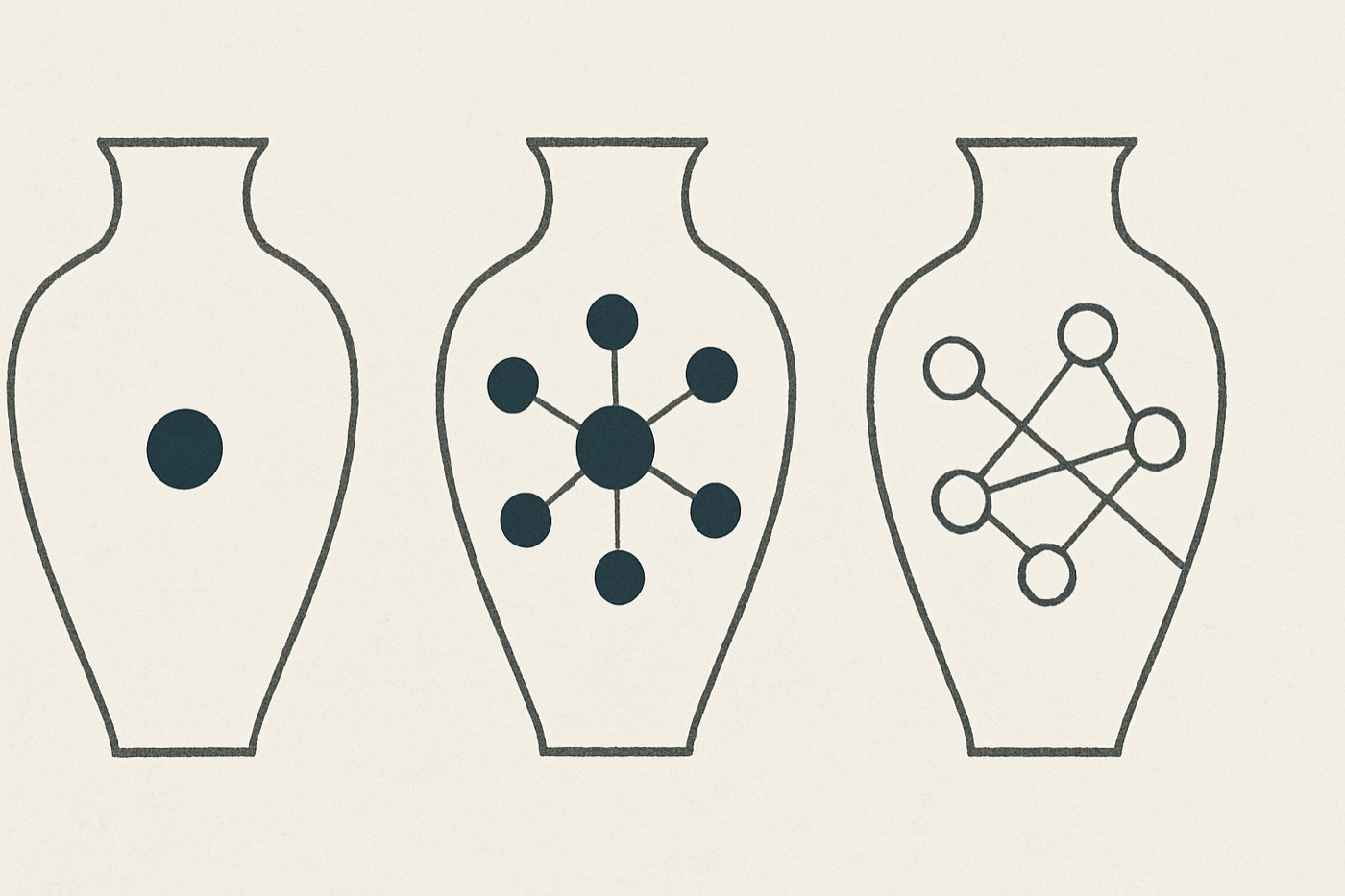
"Business" is one word doing the work of at least three different arrangements, and most of the confusion founders feel about their own company starts right there.
The first is an income-producing activity. A person does skilled work and gets paid for it: a consultant sells sessions, a designer takes on briefs, a tradesperson takes on jobs. The revenue can be excellent. It sits mainly in the time, judgment, and presence of one individual, and if that person stops working, the income stops with them. That isn't a flaw waiting to be corrected. It's simply what the arrangement is.
The second is a founder-dependent business. There's a team now, maybe a brand, repeat customers, a system or two, staff to handle the phones and manage delivery. From the outside it looks like a real company, and in most legal and financial senses it is one. The trust, the hard calls, and the final word on quality still concentrate around one person, though. The business exists. Its center of gravity has never actually moved off the founder.
The third is a designed business. The founder can still matter enormously here. Their judgment, their standards, their reputation can remain part of what makes the offer work. The difference is that some of that value has turned into something the business itself carries: a method, a standard, a decision rule, an escalation path, a way information reaches the right person without anyone having to ask the founder to remember it.
Size doesn't sort these three. A four-person studio can be genuinely designed if it has a clear promise, a reliable way to deliver it, and a way of noticing when it's falling short. A four-hundred-person company can still be, underneath its org chart, one large founder-dependent business wearing a headcount as a disguise.
*The Designed Business* names these three conditions because founders rarely do, and the test that actually separates them has nothing to do with revenue, team size, or how the company sounds at a dinner party. It's blunter than that: can the value the customer is paying for be reproduced by the business, or only by the person?
A Catering Business at Three Different Points in Its Life
Consider a composite example. A private chef starts out cooking for a handful of families each week. She takes the enquiry, plans the menu, buys the produce, cooks the meal, and delivers it herself. Every dollar she earns is a direct trade for her own time and skill. This is an income-producing activity, and for years it's a good one. She works when she wants, charges what her reputation supports, and turns away anything that doesn't interest her. Nothing about that arrangement is broken. It simply is what it is.
Word of mouth eventually grows her client list past what one person can cook, so she hires two chefs and starts taking corporate events alongside private dinners. Five years later she has a small commercial kitchen, seven staff, and a booking calendar that runs months ahead. But every menu still gets her final tasting before it leaves the kitchen. Every event above a certain size, every client who's hosted something important before and knows exactly what they want, still asks for her by name and gets a call from her personally. Her staff are talented cooks. None of them has ever been told what she's actually checking for when she tastes a dish before it goes out, because that standard has only ever lived in her mouth and her memory. This is a founder-dependent business: real, valuable, staffed, and still entirely dependent on one person's palate and presence.
The shift into a designed business wouldn't show up as a bigger kitchen or another hire. It would show up the day she writes down, specifically, what she's actually tasting for: not "good food," but four or five concrete things a dish has to do before it's ready to serve, things a head chef could learn to check without her standing there. It would show up when a client asks for her personally and someone can explain, accurately, why that isn't necessary for this particular event, and mean it. Nothing about the food, the client list, or the revenue would need to change for that shift to happen. What changes is where the standard lives.
Why These Aren't Stages on a Ladder
It's tempting to treat those three as stages, each business climbing automatically from the first to the third as it grows. That isn't how it works, and assuming it is tends to send founders looking for the wrong fix.
An income-producing activity isn't an unfinished version of a designed business. A specialist who wants to keep working with a handful of clients, charge well, and stay personally close to the work has made a legitimate choice. It isn't half finished. The trouble starts when that same person wants an outcome the arrangement was never built to produce: a buyer, a team that runs without them, income that keeps arriving after they've stopped showing up. That mismatch, wanting a result the current design can't create, is the actual problem. The category itself never was.
A founder-dependent business carries a different risk. It's easy to mistake a team, a brand, and a system or two for proof the business has already crossed into the third category. Hiring people doesn't move a business between categories by itself. It just adds more people whose work still depends on checking with the same person before anything that matters gets decided. A company can accumulate staff for a decade and never once shift its center of gravity anywhere.
Which One Are You Actually Running?
A few honest questions, not for scoring yourself against some ideal, but for finding out which of the three sentences actually describes what's been built.
If you took a genuine month away, no calls, no messages, would the work keep arriving at roughly the same quality, or would it thin out the moment you weren't the one answering?
Can you name, specifically, what you personally check, decide, or approve that nobody else has ever been shown how to check, decide, or approve?
If someone offered to buy what you've built tomorrow, what would they actually be buying: your future working hours, or something that keeps producing value with you nowhere near it?
Before the Next Decision About the Business
Most founders don't make a considered choice about which of these three they're running. They inherit whichever one accumulated while they were busy serving the next client. That isn't a failure of ambition. It's just what happens when a business grows faster than anyone stops to examine it.
Naming the category honestly doesn't fix anything by itself. It changes what the next decision should actually address. A founder running an income-producing activity who wants something shaped by a future sale or a team-led growth model needs to build economics that don't require her name on every job. A founder running a founder-dependent business who wants to eventually step back needs to find out exactly what she's still personally carrying, and start moving pieces of it into the business, on purpose. Neither problem gets solved by working harder inside the arrangement already in place.
If this distinction landed, send it to a founder who's convinced they've built a business but privately isn't sure. It tends to be an easier conversation to have about someone else's company first.