
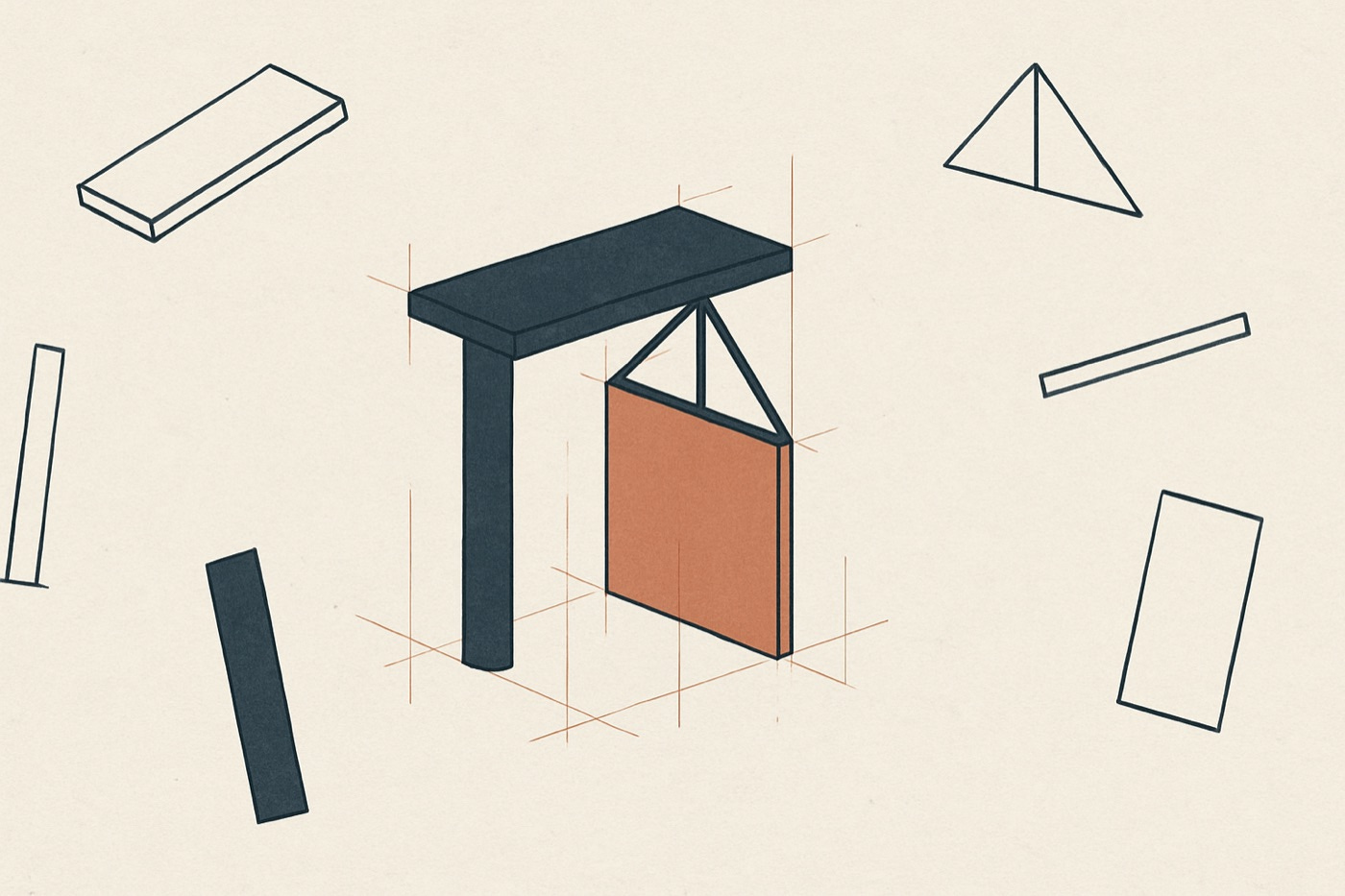
At some point, most growing businesses reach for the same word: structure. The business needs to become "more professional, more structured, more like a proper business." In practice that usually means an org chart, a staff handbook, a project management tool, and a weekly reporting rhythm. All reasonable things to want.
Eighteen months later, the org chart exists. So does the handbook. Meetings happen on a schedule instead of whenever something breaks. And the business still runs exactly the way it always did: every important decision waits for the same person, every awkward client conversation gets escalated to the same desk, every new hire spends their first six months learning things nobody ever wrote down.
The paperwork changed. The business underneath it didn't.
This confusion is worth naming precisely because it looks like progress from almost every angle except the one that matters. Formality is not design. A business can accumulate structure, documents, dashboards, and layers of management, and still have no real answer to the questions that decide whether it can carry weight without buckling.
So what does "designed" actually mean, if it isn't size, headcount, or paperwork?
When Structure Isn't the Same as Design
A two-hundred-person logistics company can have an approvals process for almost everything and still be unable to say, in one sentence, which customer problem it exists to solve. Ask five people in five different departments and you'll get five different answers, all plausible, none quite matching. A three-person design studio can run with almost no formal process at all and still know exactly why clients choose it, what they're actually buying, and what happens if a job goes wrong.
Neither company's size tells you which one is better designed. Only the questions do.
This cuts the other way too. A business doesn't earn the label "designed" just by staying small and informal. A solo consultant who has never written anything down, and whose entire practice would stop the day she gets sick, isn't undesigned because she lacks a handbook. She's undesigned because nobody, including her, could say with confidence what happens to a client relationship if she's not the one holding it. Smallness protected her from finding that out. It didn't fix it.
Design and formality are simply different axes. A business can be informal and well designed, formal and badly designed, or any combination in between. Confusing the two leads founders to chase the wrong fix: adding structure to a business that actually needs clarity, or avoiding structure in a business that's confusing informality for freedom.
Five Questions Every Business Answers, One Way or Another
Underneath the paperwork, every business is making the same five kinds of decisions, whether or not anyone sat down to make them on purpose.
Which problem is the business taking responsibility for? What change does the customer actually walk away with, distinct from what gets delivered to them? Why should someone believe the promise before they've experienced it? How does the promised result actually get produced when the founder isn't the one producing it? And what does the business do differently after something goes wrong, beyond fixing that one instance?
Call these Problem, Value, Trust, System, and Learning. They aren't five separate departments or five items on a checklist. They're five questions a business cannot avoid answering, because a business that has no answer to "which problem" or "why believe us" still operates as though something had been decided. Someone said yes to the first customer who showed up. A senior person's judgment quietly became the whole trust model. A team learned to route anything unusual to whoever fixed the last one. Nobody wrote any of it down, and it became the answer anyway.
That's the real distinction underneath this whole framework: not whether a business has answers, but whether those answers were chosen or just accumulated. A chosen answer can be examined, defended, and changed on purpose. An accumulated one usually can't be explained at all, only pointed to, the way you'd point at a load-bearing wall nobody remembers building.
There's a sharper test worth applying here, and it's the one I'd actually use to check whether something counts as designed rather than merely decided in someone's head. Could a second person, someone other than the founder, state the answer back accurately, without checking first? If the answer to "what problem do we solve" or "why should someone trust us" only exists reliably in one person's head, it isn't a design yet. It's a habit with that person's name on it. The moment it survives being said by someone else, in roughly the same way, it has become something the business actually owns.
A Bookkeeping Practice and a Marketing Agency
A composite comparison makes this concrete. Picture a three-person bookkeeping practice serving trades businesses: electricians, plumbers, small building contractors. The founder can state, without hesitating, what her clients are actually buying: not "bookkeeping," but the ability to make pricing and hiring decisions without guessing whether the business can afford them. Every client gets the same monthly reporting format, built around three numbers that answer that specific question. When a client's numbers look wrong, there's a standing rule about who flags it and how fast. Nothing about the practice is elaborate. All of it is legible. Either of the two staff members could explain the promise to a prospective client and land on nearly the same words the founder would use.
Now picture a sixty-person digital marketing agency down the street. It has a proper org chart, a account-management handbook, a shared drive full of case study templates, and a weekly leadership meeting with a fixed agenda. Ask three different account managers what the agency actually promises a new client, and you'll get three different answers: "results," "a strategic partner," "more leads." None of them wrong exactly, none of them the same thing. When a campaign underperforms, the response depends on which account manager picked up the account and which senior strategist they happen to be friendly with. The agency has far more structure than the bookkeeping practice. It has considerably less design.
Neither business is a cautionary tale about ambition or a fable about staying small. The comparison exists to isolate one variable: legibility of the five answers, independent of headcount, revenue, or how many binders sit on a shelf.
What Deliberate Design Actually Looks Like
None of this requires a founder to slow down, overthink every decision, or bury a young business under process before it's earned the right to have any. Early businesses need speed, closeness to customers, and a tolerance for improvising. The point isn't to eliminate accident. It's to notice when an accidental answer has quietly hardened into the permanent one, and to make it deliberate before growth puts real weight on it.
In practice, deliberate design tends to look small and unglamorous. It's a founder who can state the problem, the promise, and the trust basis in the same words twice in a row, a week apart. It's a team that has actually been told, not just assumed to know, which decisions they're allowed to make without asking. It's a business that changes something structural after a mistake, not only apologizes and moves on. None of that requires size, funding, or a management consultant. It requires the founder to have actually decided, out loud, in a form someone else could repeat.
Five Sentences Worth Trying to Write
A short exercise makes the gap visible. Try writing one plain sentence for each of the five, no qualifiers, no hedging:
The problem we take responsibility for is __________.
The change a customer walks away with is __________, not the thing we hand them.
Someone should believe our promise before trying us because __________.
When I'm not the one delivering, the result still happens because __________.
The last time something went wrong, what we changed afterward was __________.
Some of these will come quickly. One or two probably won't. The sentence that's hardest to finish, or that only makes sense with several extra clauses attached, is usually pointing at the part of the business still running on memory and improvisation rather than design. That's not a failure. It's information about where the next real work is.
Before the Next Handbook
None of this is an argument against structure. Org charts, handbooks, and reporting rhythms can genuinely help a business that already knows its own answers communicate them consistently. The mistake is expecting the paperwork to generate the answers it was only ever meant to record.
Before the next hire, the next handbook, or the next round of "getting more organized," it's worth writing the five sentences honestly and seeing which one gives you trouble. That sentence, more than the org chart, is the real state of the business.
Try writing the five sentences above about your own business, and reply and tell me which one was hardest to finish. That answer is usually more revealing than anything an org chart shows.