
A residential solar installation company spends eighteen months building a slow, honest pipeline. A handful of referrals a month. A website that ranks for a few local search terms. A sales process that converts slowly, mostly because it only converts people who genuinely understand what they're buying and what it will take to install it.
Then a quiet quarter arrives. Leads thin out, the installers have gaps in their schedule, and the founder, under pressure to keep the business moving, doubles the digital ad budget and sharpens the headline: *cut your electricity bill in half within twelve months, guaranteed.*
Leads triple inside six weeks. The sales team is busier than it has ever been. For a moment, the slow quarter looks solved.
The Backlog the Ad Can't See
The installation backlog is the first thing to stretch. Crews that used to spend a full day on each site, checking roof orientation, assessing shading, walking the customer through what their own usage pattern would actually support, start moving faster because the calendar is already full before they finish the job in front of them.
Some customers still get the careful version of the process. Others get the rushed one. A roof with heavy afternoon shade gets measured quickly rather than carefully, and the system sized for it never quite produces the number in the headline. A customer whose usage pattern doesn't match the typical household the guarantee was modeled on finds that out three months later, from their own bill, not from anyone at the company.
Support starts fielding a specific kind of call. Not "how do I use this," but "why doesn't my bill look anything like the ad I clicked on." Revenue is up. Lead volume is up. So, quietly, is the number of people who feel they were told something that wasn't quite true.
Marketing Distributes a Promise. It Doesn't Correct One.
This is the distinction worth sitting with: an ad campaign, a sharper headline, a better landing page, none of it checks whether the promise underneath is accurate, or whether the business can actually deliver it at the volume the campaign is about to generate. Marketing's job is to move the promise, whatever shape it is already in, in front of more people, faster than word of mouth would.
If the promise is sharp and the business can back it at scale, that is growth doing exactly what it should. More attention finds more of the right customers, and the business already knows how to serve them.
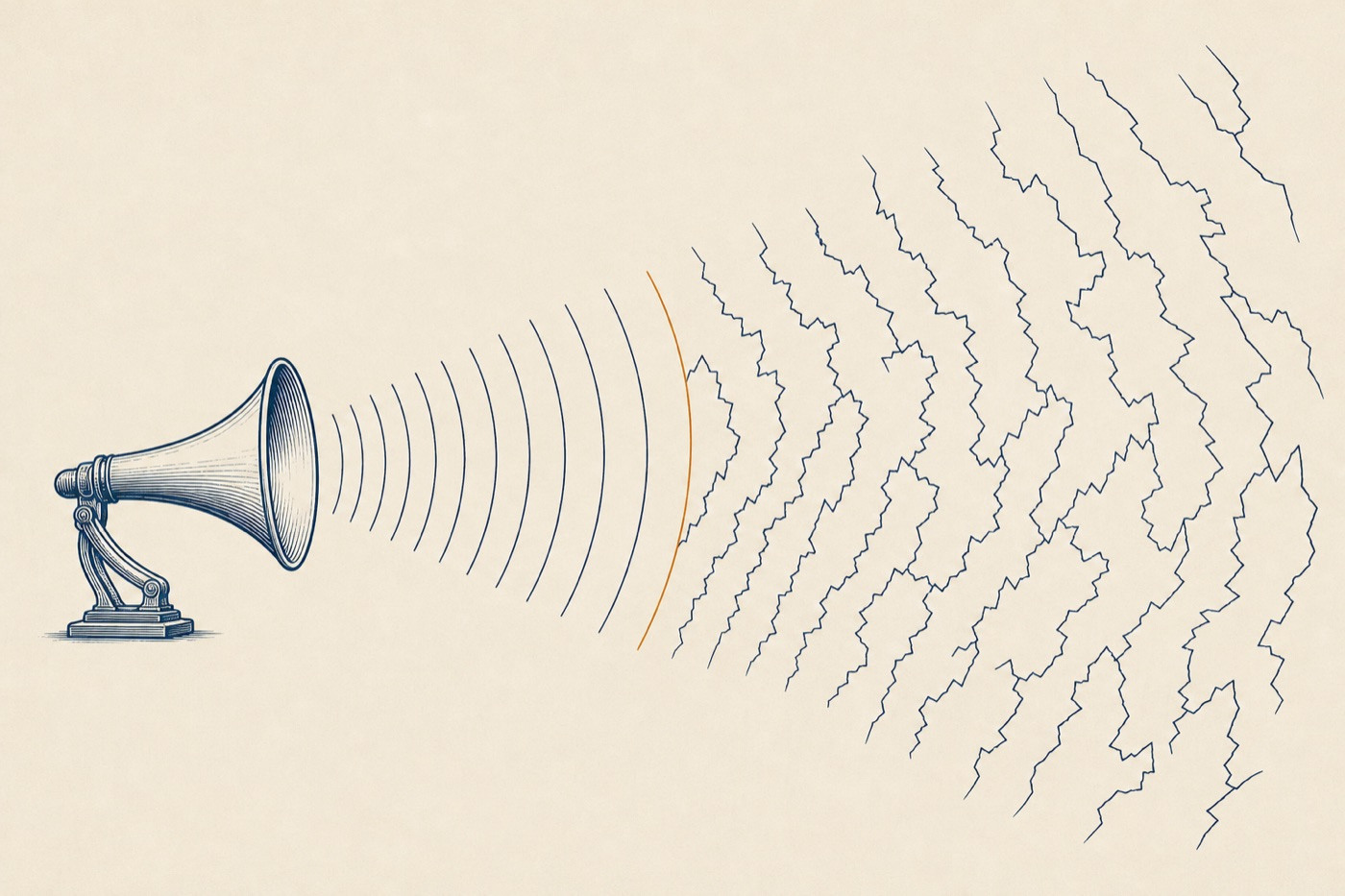
If the promise is sharp but the business can't yet back it, or the specific number inside the promise was always a little optimistic for a meaningful slice of the audience, marketing doesn't surface that gap. It buries it under a wall of new customers, for a while. *The Designed Business* frames this plainly: marketing can amplify clarity, and it can amplify confusion just as easily. It carries whichever one it's handed.
The slowdown that sent the founder toward more marketing in the first place usually wasn't a visibility problem to begin with. It only looked like one, because a thin trickle of leads kept the gap in the offer small enough to absorb quietly. Attention didn't create the gap. It just stopped letting the business hide it.
What the Extra Leads Actually Revealed
Once the complaints started, the useful question wasn't whether the ad was dishonest. It wasn't. People clicked it because it said something specific and appealing, which is exactly what an advertisement is supposed to do.
What broke was underneath, in two separate places. The savings figure in the headline assumed a roof orientation and usage pattern that only held for roughly six in ten of the households that clicked through, because it had been modeled on the company's best early customers rather than its average future one. And the installation timeline the sales team quoted had been true when two crews had light schedules. It stopped being true the week the third new booking of the day started landing on the same calendar.
Neither of those facts was visible from the ad itself. Both became visible the moment the ad started working, because working meant volume, and volume is what exposes an average instead of a best case.
Before the Next Campaign
None of this is an argument against marketing, any more than Chapter 2's companion sections are arguments against hiring, tools, or AI. A business with a clear, deliverable promise should want more attention on it. The argument is about sequence: attention should follow a check on what it's being invited into, not substitute for one.
Three questions are worth running before the next dollar goes toward visibility.
Questions before increasing spend
Can the business already deliver this promise consistently to the customers it has right now, or only to its easiest, best-fitting ones?
If the number in the campaign tripled overnight, which part of the business would be the first to show the strain, and has anyone actually looked at that part recently?
Is the attention being bought to reach customers the business already knows how to serve well, or to find out, by trial, who the business can and can't actually serve?
A business that can answer the first question honestly is usually safe to spend more. A business that answers it by assuming the delivery team will "figure it out" is about to learn the answer from its complaint volume instead.
Growth in Reach Is Not the Same as Growth in Capability
More leads, more content, more reach: all of it increases how many people encounter the promise. None of it changes whether the promise is accurate or whether the business behind it can carry the weight of a larger audience believing it.
That is not a reason to market less. It is a reason to check the promise before turning up the volume on it, because the check gets more expensive, not less, the longer it waits. A business that fixes its promise before it amplifies grows into a clearer version of itself. A business that amplifies first finds out exactly where the promise was weak, from its own customers, at a scale it chose and can no longer quietly absorb.
If this is a pattern worth recognizing before your own next campaign goes live, rather than after, join The Designed Business newsletter. It's where this kind of distinction gets made before the money is spent, not after the complaints start.